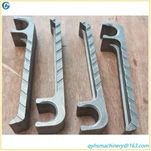
Because of the wide variety of castings and different shapes, the specific production process of each castings has its own characteristics and varies greatly. These factors directly affect the accuracy of gating system design results. For this purpose, castings can be classified in a certain way. For medium and small castings, it can be classified according to the characteristics of casting production process. The model cluster combination can reflect the characteristics of castings and the filling form of castings. The section size of each part of the pouring system is related to the size of the casting, the combination of model clusters and the number of pieces per box. Therefore, when designing the process of new castings, it should be calculated according to the characteristics of castings and the characteristics of the gating system of similar castings.
The taboo in the casting operation of lost mold casting is intermittent casting, which is easy to cause cold insulation defects in castings, that is, the temperature of the metal liquid poured in first decreases, resulting in cold insulation between the metal liquid poured after. In addition, closed gating system is used to keep the stability of gating. In this regard, the form of pouring cup is closely related to the stability of pouring operation. During pouring, the liquid level in the pouring cup should be kept stable to make the pouring dynamic pressure head stable.
Alloy steel having high strength and good chemical stability at high temperature. It includes oxidation resistant steel (or high temperature non-peeling steel) and heat strength steel two types. Oxidation resistant steels generally require better chemical stability, but bear lower loads. The thermal strength steel requires higher high temperature strength and corresponding oxidation resistance. Heat-resistant steel is often used in the manufacture of boiler, steam turbine, power machinery, industrial furnace and aviation, petrochemical and other industrial sectors of parts working at high temperatures. These parts require not only high temperature strength and high temperature oxidation corrosion resistance, but also sufficient toughness, good machinability and weldability, and certain organizational stability according to different uses. In addition, some new low chromium nickel resistant steels have been developed.