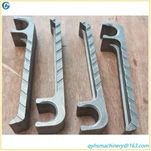
EN 10295:2002 is the technical standard for heat-resistant steel castings formulated by the European Organization for Standardization (CEN), which mainly stipulates the material requirements, chemical composition, mechanical properties, testing methods and application fields of heat-resistant steel castings. Here is an interpretation of the main content of the standard:
1. Scope of application of the standard
EN 10295:2002 is suitable for heat resistant steel castings used in high temperature environment, these castings are usually used in industrial furnace, heating equipment, gas turbine, aero engine and other fields, requiring excellent high temperature oxidation resistance and high temperature strength.
2. Material requirements
-Chemical composition: The standard clearly specifies the chemical composition of heat-resistant steel castings, including basic elements such as carbon (C), silicon (Si), manganese (Mn), phosphorus (P), sulfur (S), as well as the content range of alloy elements such as chromium (Cr) and nickel (Ni). The proportion of these elements directly affects the high-temperature oxidation resistance and mechanical properties of the casting.
-Role of alloy element: chromium is the main alloy element, used to improve the high temperature oxidation resistance of steel; silicon and aluminum as auxiliary elements, can enhance the stability of the oxide layer, but excessive will reduce the mechanical properties.
3. Mechanical properties
-High temperature strength: Heat-resistant steel castings should maintain high tensile strength and yield strength at high temperature to ensure their carrying capacity in a high temperature environment.
-elongation and impact toughness: The standard also specifies the elongation and impact toughness indicators to ensure their plasticity and impact resistance at high temperatures.
4. Detection method
-Ultrasonic detection: Due to the coarse grain and poor sound permeability of the casting, ultrasonic detection is the main method to detect internal defects. Through the reflection of the high-frequency sound beam inside the casting, the common defects such as air hole, shrinkage hole and sand eye can be detected.
-Common defects and causes: The standard also lists the common defects of castings (such as stoma, sand hole, shrinkage hole, etc.) and their causes, which provides a reference for quality control.
5. Application field
EN 10295:2002 standard heat-resistant steel castings are widely used in the following fields:
-Industrial furnace: such as furnace floor, heating components, etc., requiring high temperature resistance and oxidation resistance.
-Energy equipment: such as gas turbine, aero-engine, etc., requiring high temperature strength and corrosion resistance.
-Other high temperature environment: such as power plant, chemical equipment, etc.
6. Association with the other criteria
EN 10295:2002 is an important standard in the field of heat-resistant steel castings, which together with other European standards (such as EN 10025 structural steel standards) constitute the European steel standard system.