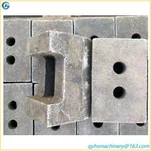
Chemical composition of Polish standard high manganese steel
PN 83160

|
grade of steel |
Chemical composition quality fraction (%) |
|||||
|
C |
Mn |
Si |
S |
P |
else |
|
|
L120G13 |
1.0~1.4 |
12.0~14.0 |
0.3~1.0 |
≤0.03 |
≤0.10 |
Cr:≤1.0 |
|
L120G13H |
1.0~1.4 |
12.0~14.0 |
0.3~1.0 |
≤0.03 |
≤0.10 |
Cr:0.6~1.3 |
|
L120G13T |
1.0~1.4 |
12.0~14.0 |
0.3~1.0 |
≤0.03 |
≤0.10 |
Cr:≤1.0 |
When the high manganese steel casting is subjected to impact interception and compressive stress, the metal surface has plastic deformation, rapidly produces processing hardening and inducing the martensite and ε phase, thus forming a hard and wear-resistant surface layer, and the patient part is still the austenitic tissue. The hardness of the surface layer is increased from about 200 HB to more than 500 HB, and the concentration of the hardening layer can reach 10~20mm, or even more. While the surface is gradually worn away, the hardening layer develops inward continuously under the action of the impact load. In the case of low impact load and low stress wear, the wear resistance of high manganese steel is often not necessarily better than other steel types of considerable hardness at the surface. Austenitic high manganese steel is non-magnetic, but also can be used for both wear-resistant and magnetization-resistant parts, such as the electromagnet cover of the suction device.
In order to meet the requirements of different working conditions, adjust the basic components and add other alloy elements, in order to improve the wear resistance of steel, some improved high manganese steel is developed. The chemical composition and use of some improved high manganese steel at home and abroad are shown in the following table.