

There are two types of inclined reciprocating grate, one is the more common general inclined reciprocating grate, and the other is the water-cooled reciprocating grate developed in recent years.
The general inclined reciprocating grate is mainly composed of fixed grate, movable grate, transmission mechanism and reciprocating mechanism.
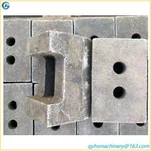
The entire combustion surface of the fire grate is composed of fixed fire pieces and movable fire pieces, each of which occupies half, and the two are stacked at intervals to form a ladder, inclined at 15°. ~20. horn. The fixed grate piece is installed and embedded on the fixed grate beam, and the fixed grate beam is then fixed on the inclined channel steel support. The movable grate pieces are mounted on the movable grate beam, and the movable grate beam rests on the rollers that are supported by the two ends of the fixed grate beam. The lower ends of both sides of all movable grate beams are connected as a whole with connecting rods.
When the motor is started, the transmission mechanism drives the eccentric wheel to push and pull the shaft and connecting rod through the movable rod and connecting rod, so that the movable grate reciprocates on the fixed grate. The reciprocating stroke is generally 30~70mm, and the coal moves downward and backward accordingly. The motor is controlled by a time relay, and the start-stop time is adjusted according to the requirements of different boiler loads and coal types.
The water-cooled reciprocating grate is mainly composed of butterfly cast iron grate, water pipe shelf, transmission mechanism and reciprocating mechanism, and the butterfly cast iron grate and water pipe shelf are of the type.
The water pipe shelf is welded to the header by a row of straight pipes at both ends, and the front and rear headers are respectively connected with the steam drum by the connecting pipe to form a circulation loop. The butterfly-shaped cast iron grate is embedded between the pipes of the water pipe shelf. The contact surface of the grate and the pipe is coated with metal powder mixed with water glass, and it is molded tightly with a module. The pot water flows in the pipe, so that the butterfly-shaped cast iron grate is obtained. cool down.
Behind the inclined reciprocating grate, some are equipped with a burnout grate (also known as an afterburn grate). The ashes basically burn out the combustibles in the grate, and then the grate is turned over to pour out all the ash. Due to the serious air leakage of the burnout grate and the complicated air adjustment, the ash pit is often sealed with water for regular or continuous slagging.
When the inclined reciprocating grate uses coal with high volatile content and fast ignition, it is easy to burn at the exit of the coal scuttle and emit smoke from the coal scuttle. In order to eliminate this defect, the secondary air can be passed through the coal gate to blow the flame to the furnace. However, a more thorough solution is to improve the coal feeding device under the coal scuttle, so that the coal leaves the coal scuttle and then passes through the pusher plate, and is sent to a deeper position in the furnace before burning.
The inclined reciprocating grate furnace is the same as the chain furnace, in order to make the coal ignite smoothly and enhance the gas mixing in the furnace, it is also necessary to arrange the furnace arch. For the specific situation of the reciprocating grate, a relatively simple inclined front arch can generally be used. When burning bituminous coal and lignite, some do not set a low and long rear arch, but use a middle arch or a partition wall to match the front arch to help the new coal ignite. The middle arch or partition wall can be completely vertical, or the lower part can be vertical and the upper part can be inclined forward. When burning bituminous coal, a vertical rear partition wall is often used, and some also have a slag retaining arch, that is, a small arch protrudes from the rear wall to radiate heat to the burnout area, so that the ash is fully burned.
The Structure Of Inclined Reciprocating Grate
Mar 03, 2023



Send Inquiry
Latest News


Contact Us
- Mob: +8615053412502
- Email: Hongsheng@hsmachineryparts.com
- Add: Bohai Road, Sub-District Office, Qingyun County, Dezhou City, Shandong Province