


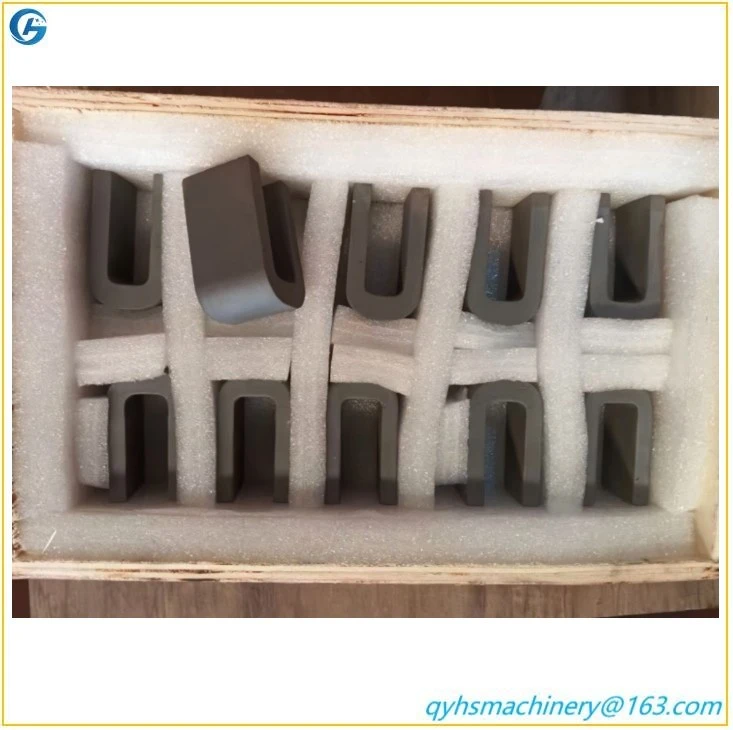


Qingyun Hongsheng Machinery Parts Co., Ltd. is one of the most reliable manufacturers and suppliers of silicon carbide ceramic special-shaped parts in China. We warmly welcome you to wholesale high quality silicon carbide ceramic special-shaped parts at low price from our factory. If you have any enquiry about quotation, please feel free to email us.

Silicon carbide ceramic, a high-performance precision material, boasts exceptional density, wear resistance, thermal conductivity, and thermal shock resistance. With strong oxidation resistance, it maintains superior bending strength at high temperatures while demonstrating stable performance over time. Its outstanding wear resistance, chemical corrosion resistance, high hardness, and mechanical stability have made it widely used in automotive applications across new energy vehicles, petrochemicals, environmental protection, and electronic engineering. We provide customized silicon carbide ceramic products including sealing rings, nozzles, discs, tubes, bases, and arms to meet diverse application requirements.
Products Description
Silicon carbide structure and properties
Silicon carbide (SiC), composed of silicon and carbon, is a polymorphic compound primarily existing in two forms: α-SiC (high-temperature stable) and β-SiC (low-temperature stable). Over 200 polymorphs exist, with the representative types being 3C-SiC in β-SiC and 2H-SiC, 4H-SiC, 6H-SiC, and 15R-SiC in α-SiC. Below 1600°℃, SiC exists as β-SiC and can be synthesized from simple silicon-carbon mixtures around 1450°℃. Above 1600°℃, β-SiC gradually transforms into various α-SiC polymorphs. 4H-SiC readily forms at 2000°℃, while 6H and 15R polymorphs require temperatures above 2100°℃ to form. Notably, 6H-SiC remains highly stable beyond 2200°℃, making it widely used in industrial applications. Pure SiC appears as colorless crystals, while industrial-grade SiC exhibits colors ranging from colorless to black, with transparency decreasing progressively. In abrasives, SiC is classified by color into black and green varieties. Green SiC includes colorless to dark green variants, while blue-green to black variants belong to black SiC. Both black and green SiC are hexagonal crystals of α-SiC, with green SiC micro-powder serving as the primary raw material for most SiC ceramics.
Silicon carbide ceramic preparation process
Silicon carbide (SiC) ceramic materials are produced through the following process: raw SiC materials undergo crushing, grinding, and classification to obtain uniformly sized SiC particles. These particles are then mixed with sintering additives and temporary binders to form green bodies, which are subsequently sintered at high temperatures. However, due to the highly covalent nature of Si-C bonds (approximately 88% covalent) and their low diffusion coefficient, one of the primary challenges in manufacturing is achieving sufficient sintering density. High-density SiC ceramics can be prepared using various methods including reaction sintering, pressureless sintering, atmospheric sintering, hot pressing, recrystallization sintering, hot isostatic pressing, and discharge plasma sintering. Nevertheless, SiC ceramics exhibit low fracture toughness and high brittleness. To address this, recent years have seen the emergence of composite ceramics based on SiC, such as those reinforced with fibers (or whiskers), strengthened through heterogeneous particle dispersion, and developed into gradient functional materials, all of which significantly improve the toughness and strength of individual components.
Application and development prospect of silicon carbide ceramics
As a high-performance structural ceramic material, silicon carbide has been increasingly applied in various fields including high-temperature kilns, steel metallurgy, petrochemicals, machinery and electronics, aerospace, energy and environmental protection, nuclear energy, and automotive industries. With the growing penetration rates in new energy vehicles, energy sectors, industrial applications, and telecommunications, coupled with increasingly stringent requirements for high-precision, wear-resistant, and reliable mechanical components or electronic parts across industries, the market size of silicon carbide products is expected to continue expanding. Notably, new energy vehicles and photovoltaic applications stand out as key growth areas in this sector.
Customization of various silicon carbide ceramic irregularities
Products Display


why choose us
Quick response Products with high cost performance Products with high cost performance

why choose our products
1. 20 years of experience in casting cast iron plate, quality assurance, timely delivery
2. Perfect machining and inspection equipment can directly provide finished parts and meet the inspection requirements of customers
3. It has independent import and export rights and can export products to all parts of the world
Hot Tags: silicon carbide ceramic special-shaped parts, China silicon carbide ceramic special-shaped parts manufacturers, suppliers, factory, Abrasion Resistant Ceramic Lined Steel Pipe And Elbow, Ceramic Lined Wear Resisting Elbow, Heat Wear Resistant Ceramic Lined Pipe Elbow, Steel Plant 95 Alumina Ceramic Lined Elbow, The Ceramic Lined Carbon Steel Pipe, Wear Abrasion Resistant Alumina Ceramic Pipe Bend Elbow


